





Archive for the ‘Blog’ Category

The Romance


by

Sunday, January 17, 2010


Read Comments (17)


Alex Raymond (1909-1956) made a certain kind of drawing that drove the boys wild. His Flash Gordon strips are the height of lush eroticism in comics (lush as compared to Burne Hogarth’s spiky cocks and taut flesh in his highly sexed Tarzan strips), his lines not finding any form, but creating it – becoming the substance of the image itself. Like a pulpier Franklin Booth, he seemed like he couldn’t help but draw the air that swept around his characters. Sometimes criticized as not being great comics qua comics, his stuff nevertheless worked best on the comics page, where sequences of drawings forgive the occasional clunker and where he could push even further than was commonly done in the pulps.

A gloss on his biography finds Raymond’s initial break in 1934, when, he debuted an astounding three strips: Dashiell Hammett’s Secret Agent X-9 (he only stayed on until 1935) and the more successful Sunday-only Jungle Jim and Flash Gordon. Flash, of course, would make his name, and he carried on until 1944, when he joined the Marines and served as an artist and designer until 1945.

Meanwhile, King Features had assigned Austin Briggs to Flash Gordon, so the company offered Raymond a strip of his own. Conceived and written with editor Ward Greene, Rip Kirby was born in 1946. Kirby is a gentleman detective complete with a golf hobby, a butler, and a bespectacled gal Friday who is not quite a lover. Kirby is moral and stern, but not without a wry sense of humor and, of course, a weakness for dames. None of the pulp madness of contemporaneous crime novels lurks within his psyche. Nope, he’s the public side of the post-WWII world: cosmetically sound and mostly sexless, all the better for him to be able to move through his various storylines while remaining mostly unruffled.


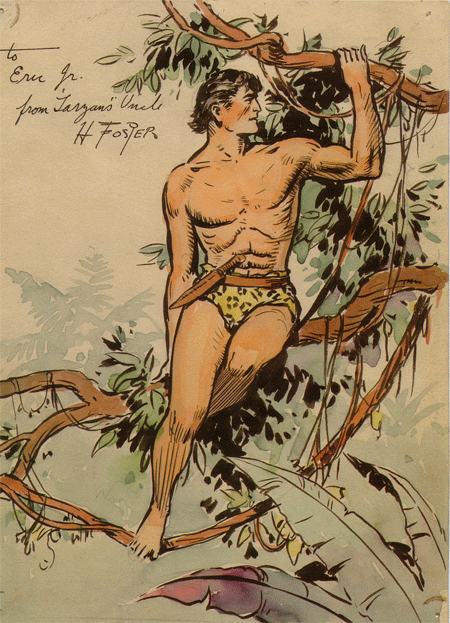
Anyhow, as you may know, IDW recently released the first volume in a comprehensive Rip Kirby reprint series. Some 300 pages of seriously high quality work reproduced beautifully. I’ve been waiting a while for this book, having only recently come to Raymond via Wally Wood, really, and following on my sudden, distressing, and then comfortable, and then soothing conversion to the many virtues of Hal Foster. It’s kind of like rediscovering the Grateful Dead as adult. You’ve passed through an unfortunate period of rejecting things your adolescent brain thinks aren’t appropriately “sophisticated” and then you come back around and realize that none of that fucking matters and your standards were mostly specious. Meanwhile you’ve made an ass of yourself rejecting all this great stuff. Well, fuck it, that doesn’t seem to be a problem for the younger kids out there (and lots of other older smart people), bless them. And I’m sort of mortified it was a problem for me. But we’re all idiots sometimes, even if those times last years.

Back to Raymond. With Rip Kirby he introduced a drawing style highly influenced by the classy illustrations found in Good Housekeeping and elsewhere – a moderate, well crafted realism that emphasized solidity and modesty without the flash and drama of the pre-War generations.


Foster was dramatic and stagey and Caniff overtly filmic and grotesque. Raymond wanted to bring a sense of fidelity (and here I mean something akin to a hi-fidelity audio recording – a highly polished simulacra of the “real” but without all the messiness of actual palms-in-the-dirt realism) into the mix – he relies on standard close-ups, over-the-shoulder shots, and crowd set-ups and avoids expressive angles and obvious dynamism. He keeps the figures rooted in the kind of photos you’d find in magazines. Nothing too far out. It’s a kind of media-based realism rooted more in images of America than any kind of documentary impulse.

For the first month of the strip Raymond uses his Flash Gordon fine line style, but a month later the art gets thick and brushy. Not Caniff brushy, but more like Al Parker brushy, and that’s where it gets really interesting.

Fine line and then brushy…


Raymond the aesthete (though not Raymond the storyteller) always seems like a hedonist, and these ink-heavy images look like they were fucking fun to make – big, juicy strokes like long honks on a saxophone (side note: I’m currently reading Larry Rivers’ autobiography, in which he has much to say about honking, which is a subject I think Frank relates to more than me, but I find interesting nonetheless) and in stark contrast to the rather pallid stories.


So, here is also where I can see Raymond’s profound influence on comic books – minus his finicky fine line style, this stuff has a surface sheen and a visceral feel that I can imagine comic book guys (many of whom hoped for strips) imitated. No hysterics here, but lots of detail and respectability.

The middle panel looks like every villain in every 1950s comic book. Except drawn to utter surface perfection. Not a line out of place. Not a move made without consideration. And dig that background stroke.

Of course, the comic book guys were saddled with lurid stories – so there you have a powerful combo: Attempts at “respectable” drawing in service to the down-and-dirty. I can see all of 1950s Ogden Whitney unfold, and Wally Wood baroque compositions, as well as John Romita, not to mention Russ Manning, and so many others. Those guys understood in a way that I bet Raymond did too, that taking that kind of technical drafting facility and cutting out the showiness of it – forcing it into the time and space constraints of a daily strip – can make it work as cartooning. The less Raymond put in – the more he feinted at realism but dove at cartooning – the more successful he is.

This realism is stunning in its facility, and the marks are beautiful, but the far more rushed drawing below kinda reads better as cartooning (um, Toth anyone?).

I haven’t said much about the stories. After all, it’s a comic. There is a blackmail storyline, there’s one about counterfitting; there’s a missing model in London; there’s even a kind of island adventure. The villains are stock and so are the situations. Kirby himself isn’t too interesting. But they move right along – I can happily sit and read them as the strips move through the basics of a plot. But really, that doesn’t matter. Rip Kirby isn’t a classic – not in the way that Mary Perkins on Stage is, or Terry and the Pirates is. I get the feeling Raymond wasn’t that interested in the “literary” end of things, so you can’t go looking for the kind of visionary experience you might have with Chester Gould or the feeling of a unique voice from Caniff. It’s an oddly impersonal strip, really. It’s all in the drawing – and that in itself is enough in this case. It gives me everything I need from the strip. The pleasures derived from Rip Kirby are unique and worth pursuing.

Judging by this first volume, Raymond’s greatest success with Rip Kirby was, in a way, inspiring the likes of Stan Drake (who was with Raymond the night of his fatal crash) and Leonard Starr, both of whom would marry Raymond’s “realism” with a sense of melodrama straight out of Douglas Sirk and snappy, well observed stories filled with moral ambiguity and undercurrents of fear and sex. The two ongoing Drake and Starr reprint series, The Heart of Juliet Jones and Mary Perkins on Stage, respectively, are my favorite finds of 2009 (the best source for info on these guys is the now defunct web site. The Look of Love). More on all of this another time.

Labels: , , , , , , , , , , ,

Jack Kirby and Caesar


by

Saturday, January 16, 2010


Read Comments (3)


Jack Kirby costume designs for Shakespeare’s play Julius Caesar.
Check it out over at the Kirby Museum.

Labels:

Cubists and Cartoonists in Chicago, 1913


by

Friday, January 8, 2010


Read Comments (6)

Clare Briggs, March 20 1913.

Modern art famously came to America in a burst at the Armory Show that opened to scandal and praise in New York on February 17, 1913. The story is often told and it’s true enough. But not quite the complete truth. In fact, there had been exhibits of modern art as early as 1911 in W. Scott Thurber’s gallery in Chicago. And on February 25, 1925 the Art Institute of Chicago hosted an “Exhibition of Contemporary Scandinavian Art” which can be seen as strongly paralleling the more famous New York show.

Frank King April 24, 1913.

For our purposes what is important is the number of top notch cartoonists who went to the show, including Frank King, Clare Briggs, and John T. McCutcheon. The show was much mocked in the press but was a popular success, attracting many ordinary Chicago residents (including Frank King’s wife Delia who went to see it by herself).

John T. McCutcheon, April 3, 1913

For months afterward, cartoonists would use cubist and futurist imagery in their work. Intriguingly, many of these comics weren’t done in the typical philistine “you call this art” mode. Rather, these artists seemed to be affectionate to the new art, and tried to assimilate it into more homespun, familiar experiences, notably Briggs’ jest that the quilt maker was the first cubist. Another cartoon showed a bear cub (symbol of the local baseball team) done in a cubist mode: “our own little cub-ist.” In effect these cartoonists were domesticating modernism.

L.W. Newbre (?), March 25, 1913

Frank King of course remained obsessed with modern art for many years, leading to the great Gasoline Alley Sunday pages where Walt and Skeezix enter into the world of abstract painting. In his personal papers, King often alluded to Picasso.

There has already been one academic paper written about the 1913 show and Chicago cartooning. Alas that paper is as yet unpublished. But more work remains to be done. The crucial question I think is this: was their a hidden affinity between comics and cubism? Did the encounter with modern art liberate King and other cartoonists to free themselves from illustration and become more abstract and cartoony? This is a story that has yet to be written.

NOTE: Robert Boyd makes an important point in a comment posted below. The Armory Show travelled to Chicago. This would explain all the cubist cartoons printed above, except the Clare Briggs one which ran before the show moved from New York to Chicago. This renders moot my speculation that the artists might have seen modernist art in earlier gallery shows. Oh well, we can still enjoy the cartoons.

So to clarify: Briggs, who did at least 2 cubist inspired cartoons, might have gone to the Armory Show in New York. King, McCutcheon and L.W. Newbre probably went to the Armory show in Chicago. The show that Delia went to was the Armory show in Chicago, not the earlier exhibit of contemporary Scandinavian art.

Labels: , , , ,

Notes on the Midwestern School of Comics


by

Tuesday, December 29, 2009


Read Comments (15)

The Comics Journal 300 carries a conversation between Kevin Huizenga and Art Spiegelman. During the course of the interview, Kevin brings up the idea of a Midwester school of cartooning, something that I’ve discussed in various essays on Little Orphan Annie and Gasoline Alley. The conversation goes like this:

Huizenga:In one of the recent Annie reprints, Jeet Heer talks in the introduction about this idea of a Midwestern, or Chicago school of cartooning that was more preoccupied with everyday life and the quiet rhythms of everyday life. The style was quieter and more repetitive. I think you can definitely see how Ware fits in that tradition, and also he’s called more attention to that kind of cartooning. Visually, it might look boring, at first, to some people, but it’s a form that’s fitted to content. What they’re doing is comics about mundane things like talking to your wife, or whatever — the “little things.”
Spiegelman:I guess. But I think rather than just Midwest, I would make it Protestant, you know. Like they don’t have those ornate crucifixions.
Huizenga:I have those two strikes against me, I guess, here. [Laughter.]
Spiegelman:It’s definitely suspicious of ornament and exuberance…

A few points can be added to this discussion. I elaborate one what I mean by the Midwestern comics tradition in an interview with Tom Spurgeon in the Comics Reporter, where I talk about this school of art and how it links together Harold Gray and Chester Brown. Here’s a relevant part of that interview:

The geography of rural Illinois left a strong mark on Gray’s imagination, as can be seen if he’s compared to his Wisconsin-born colleague Frank King. In King’s work, the country-side is always rolling and sloping, with cars constantly sputtering up hills or flowing down valleys. In the early Little Orphan Annie strips, by contrast, once our heroine leaves the city, the countryside is as flat as a quilt spread out on a bed, each acre of farmland its own perfect square, with stacks of hay and isolated silos the only protrusions on the land. The flatness of the prairies, the prostrate manner in which the horizon spreads out as far as the eye can see, spoke to something deep in Gray’s imagination: it perhaps explains his sense of the isolation of human existence, the persistent feeling of loneliness his characters complain of, and their commensurate need to reach out to Annie and create strong (although temporary) families, with the orphan as their child.

Brown of course didn’t grow up in the prairies, which are the setting for Louis Riel. His childhood was spent in the very different landscape of Quebec. But I do think that appropriating Gray’s style helped Chester capture the landscape of western Canada, especially the flatness and isolation of the region. I do think there is a tradition of mid-western cartooning, a family tree that is rooted in John T. McCutcheon and extends to Clare Briggs, Harold Gray, Frank King (with a crazy branch that includes the grotesque approach of Chester Gould and Boody Rodgers). The latest branch of this tree is the alternative comics of Chris Ware, Ivan Brunetti, and Kevin Huizenga. Brown is interesting because he’s not from the mid-west at all, in fact is not even an American, but has absorbed the aesthetics of this
approach.

A few other points:

1. Spiegelman is on to something when he says that this is a Protestant tradition. What I’d say is that the tradition of Midwestern comics brings together various strands: partially regional tradition of vernacular, low-key literature (the line of George Ade, Sherwood Anderson, Ring Lardner) with its focus on small town life, partially from the low church Protestant tradition of plainness, partially out of the Chicago Tribune’s populist stance. So I prefer the more expansive term Midwestern cartooning, which seems to bring most of these things together. But perhaps we could also say that this is Midwestern Wasp cartooning?

2. If we were doing a genealogy of ideas, credit for the concept of Midwestern catooning should go to Gilbert Seldes, who talked about the “Chicago school” in his 1924 book The 7 Lively Arts. In the 1980s, Richard Marschall revived the idea of Midwestern cartooning in a few scattered essays in Nemo magazine. I’ve tried to give a third life to the idea by linking up the great Chicago Tribune cartoonists of the 1920s with their modern counterparts like Ware and Huizenga.

Labels: , , , , ,

Frank Takes to the Internet to Talk About Multiforce


by

Monday, December 21, 2009


Read Comments (14)

Go to the Comics Reporter to learn more.

Labels: , ,

Anthology Making as Autobiography


by

Saturday, December 19, 2009


Read Comments (26)

Dan’s comments on the Toon Treasury got me thinking about anthology-making, an underappreciated craft. In the entire history of comics, there have only been a handful of great anthologies. Off the top of my head the following come to mind:

1. The Smithsonian Book of Newspaper Comics, edited by Bill Blackbeard and Martin Williams. A really great anthology, collecting the best strip comics from the early 20th century: Opper, McCay, Herriman, Sterrett, Gray, Segar, Crane, Gottfredson. This book is the foundation stone of the reprint renaissance we’re living through right now. There is no way, for example, that the Walt and Skeezix books would exist if the Smithsonian volume hadn’t published choice examples of King’s Sunday pages, which led Joe Matt and Chris Ware to collect Gasoline Alley strips. The book is particularly strong on the great long and rousing continuities of the 1930s that Blackbeard grew up reading: giving readers an extended sample of Wash Tubbs, Mickey Mouse, and Popeye at their violently exuberant best. It took me many years to figure out that the book has some limitations. The editors had no taste for adult observational humour panels, so there is no Clare Briggs or Gluyas Williams in the book. And because Blackbeard’s taste was so nostalgically oriented, the book peters out after 1945 or so. Still, this is an essential volume that anyone interested in comics should own.

2. The Toon Treasury of Classic Children’s Comics edited by Art Spiegelman and Francoise Mouly. Dan has already said what needs to be said about the book. The one point I’d add is that it does a useful job in sorting out a canon of the really great kids cartoonists (Barks, Stanley, Kelly, Mayer) while providing enough material from other artists who did solid work so that readers get a sense of the scope of the genre.

3. Art Out of Time edited by Dan Nadel. This is probably too incestuous but I have to say this book looks better every time I return to it. This is especially true now that we have more books reprinting some of the artists from this anthology: what distinguishes the book is the fact that the stories Dan selected were both striking and emblematic of the cartoonists being displayed. About the only critique I’d make is that the comic book pages looked better than the newspaper Sunday pages reprinted. It might have been better to have two volumes, one devoted to the comic book stories and a larger book to the Sunday pages.

4. An Anthology of Graphic Fiction, Cartoons, and True Stories, two volumes, edited by Ivan Brunetti. There is so much that could be said about these books. I love the connections they draw between classic cartoonists (notably Bushmiller, Kurtzman and Schulz) and alternative comics. Like Spiegelman and Mouly, and Dan as well, Brunetti is very smart about how he’s organized the book: the unexpected juxtaposition of certain artists (Forbell and Regé, Teal and Burns) ignites a new understanding of familiar material. And I like that the Crumb material is from his underrated middle period, and not the overly reprinted 1960s stuff. More subtly, Brunetti has a knack for picking out stories that stick in your mind. Much of this book was déjà vu for me, but that’s because so much of it is from the very stories that I’ve constantly been re-reading for the last twenty years.

5. McSweeney’s 13 edited by Chris Ware. All the praise of Brunetti’s book applies to this volume.

Aside from these books, there are a few near great anthologies: books that are very strong but more flawed, including A Smithsonian Book of Comic-Book Comics (edited by Michael Barrier and Martin Williams) and The Apex Treasury of Underground Comics (edited by Don Donahue and Susan Goodrick). The Smithsonian book suffers mainly from its half-hearted selection of superhero and action material (which either should have been more comprehensive or entirely left out), and the dull coloring of the reproduction. The Apex book gives a good selection of the main underground artists but many of them would go on to do stronger work (notably Spiegelman, Spain, and Deitch; actually also Crumb, now that I think of it). So it’s crying out to be republished in an expanded edition. Or perhaps someone can start from scratch and do an anthology of “The Essential Underground Comics”.

One interesting thing about good anthologies is how autobiographical they are. It’s no accident, I think, that the Smithsonian Book of Newspaper Comics is strongest on those comics Blackbeard and Williams read when they were boys in the late 1920s and 1930s. The Toon Treasury is an outgrowth of the experience Spiegelman and Mouly had as parents, sharing Barks and Stanley with their kids. And some of the selections in the Toon Treasury are either personal interests of Spiegelman (Jack Cole), influences on his work (Gross, Kurtzman) or in one case his mentor (Woody Gelman). The Yale anthologies are really a record of the comics that shaped Brunetti’s own development as a cartoonist.

Anthology-making can thus be seen as a form of autobiography. A good anthologist is moved not just by objective considerations (who are the masters of the genre?) but also personal concerns (what are the works that speak to me?). This personal dimension of anthology-making extends outside of comics: consider Dwight Macdonald’s Parodies, or John Metcalf’s many collections of Canadian short fiction, or Hugh Kenner’s volume of Seventeenth Century Poetry or the Subtreasury of American Humor edited by E.B. and Katharine White. All of these are anthologies that bear the impress of particular personalities, with items selected and organized to sharpen taste and perception.

PS: I should add that there are some very attractive-looking recent anthologies which I haven’t read yet: notably Abstract Comics by Andrei Molotiu. So if there are books that I missed, feel free to list them below in the comments section.

Labels: , , , , , , , , , , ,

A Little on Makoto Aida


by

Friday, December 18, 2009


Read Comments (5)

I imagine Makoto Aida being a kid who wanted to draw manga like Suehiro Maruo, and then the kid grew up to become a gallery artist. I don’t think he’s that well known in American comics circles, maybe because his work is so explicitly about Japan or because comics is a very small part of what he does. Like a lot of contemporary artists, he works across mediums: sculptures, paintings, performances, videos, plans for housing projects, whatever. He painted a quick Fuji watercolor image over his BFA diploma and sold it for the price of the university entrance fee. (After selling it he said: “Though I am not supposed to say, art is so strange.”) And he doesn’t make dividing the works easy; his (beautiful) monograph Monument for Nothing catalogs his works by color, as opposed to chronologically or by medium or theme. All of the mostly blue works are grouped together, the mostly white works, etc. He’ll break up a series of works if the colors of the individual parts are different.


His main comics effort, Mutant Hanako, is actually a continuation of his “War Picture Returns” series of paintings. Here’s how Aida describes the story, from Monument for Nothing: “With the setting of the Pacific War, it is a mixture of elements of extreme nationalism, brutal erotic depiction, and airheaded adventurous action, which as a whole is closer to simply ridiculous absurdity than a crazy constructed air castle.” There’s a good plot summary of the book here: http://everything2.com/title/Mutant+Hanako


In his more cartoony work, he alternates between very immediate drawings (Mutant Hanako is an example of that, and his “Minna to Issho” series) sort of like Takashi Nemoto and heta-uma (he’s described heta-uma as “a style of illustration and graphic design which was hot [in the eighties]”), and more illustrative, detailed images that resemble Suehiro Maruo. I like how it’s common among mangaka to draw in such a similar way to other mangaka. It’s like the drawings are just about functioning to create a story. The story/storytelling is where the individual is. But, in Aida’s case, he’s somewhere between being a regular fan mangaka and a pop artist. He’s using something that he likes, as Takashi Murakami does. But Aida’s much warmer than Murakami. Aida’s more like underground comics. It’s all very hand-done.

A side note:
I have the Japanese printing of Mutant Hanako and there’s an English translation of the work in the back of it. That’s rare among manga and more common among art books, so I don’t know if it’s because they thought of it as an art book more, or it could possibly be in reference to the crazy American/Japanese relationships in the Mutant Hanako story. Anyway, I’d like to see more of these limited-audience manga be translated on separate pamphlets (by an English publisher/distributor) that would then be inserted into the original printing of the book, and then distributed online through the English publisher. Obviously it isn’t as ideal as a fully translated new book, but beggars can’t be choosers when it comes to manga translations with such a small potential audience.

Labels: , , ,

Going Faster Miles an Hour


by

Friday, December 18, 2009


Read Comments (2)

I’m not sure why Robin McConnell chose this image to illustrate the “Best of 2009” Inkstuds radio show — we never ended up discussing Blackest Night, even though I read all five issues to date in preparation. (Fellow show guest Sean T. Collins, apparently a sadist, chose it as a potential topic.) Robin, Sean, Chris Mautner, and I did end up talking about a bunch of other 2009 highlights, though, and if for some reason you haven’t had your fill of comic-book blather this holiday season, you can listen to the show yourself here.

Actually, I kind of wish we had had the time to cover Blackest Night, which isn’t really good, but does represent a kind of ultra-meta-state-of-the-comics-industry symbolism that is almost impossible not to appreciate on an abstract level, whether or not it’s worth reading. (It isn’t, unless for “scholarly” purposes.) Then again, the subtext (or is it just text?) in question is pretty obvious, so it’s not like anyone needed a bunch of pointy-headed critics to draw it out.

Labels: , , , , ,

Ben Jones


by

Monday, December 14, 2009


Read Comments (3)

Well, here is something: Ben Jones on the New York Times T Magazine web site. Go watch the video.

Labels: ,

Irving Tripp R.I.P.


by

Sunday, December 13, 2009


Read Comments (2)

Via Steve Bissette, Tom Spurgeon broke the news of Little Lulu artist Irving Tripp’s passing. This was all the more shocking for many of us selfish historian-types because, as Tom noted, we weren’t aware he was still around all these years. So, Jeet had the idea to reprint the one interview known to exist with Tripp, from Another Rainbow’s Little Lulu Vol. 16 (1985).

Anyhow, now CC pal Seth has graciously supplied these scans of that fascinating interview, posted here with permission. Click to enlarge each scan to reading size. Thanks to all, and thanks to Irving Tripp, a master cartoonist.

Labels: , , ,