Resisting Prince Valiant


by

Thursday, September 10, 2009


Read Comments (12)

In my experience, Prince Valiant is an easy comic strip to admire (all that evident artistry, that labor-intensive craftsmanship) but a hard one to warm up to. In his recent, very persuasive posting on Hal Foster, Dan admits that it took some work on his part to find a way into Prince Valiant. I think for a certain type of reader, resistance to Prince Valiant is a natural instinct. Any appreciation of the strip has to come to terms with why it can be, at least on first glance, so off-putting.

To my mind, the best account we have of this forbidding and stultifying quality in Foster’s work comes from the fiction writer Clark Blaise. In his 2001 collection Pittsburgh Stories, there is a tale called “Sitting Shivah with Cousin Benny” where the narrator offers this illuminating riff:

Every Sunday for as long as I’ve been conscious, there’s been a Prince Valiant on the comic page. It can’t die, it’s eternal, and I’ve never read a single panel. It’s beautifully drawn, and the most literate script in the paper, postmodern before there was Postmodernism, new age before there was New Age, camp before there was Camp. With all that mad hair, that costuming, that intricately irrelevant story line, you’d think he’d have his lone, crackpot, visionary advocates, but no one talks about him, he has no explicators. Even Krazy Kat has its exegetes. What mad consortium thought him up, who pitches his stories every week, who keeps churning him out? Who pays for it? Has anyone ever read Prince Valiant? It’s too late for me to start, too much has gone on, I can’t enter that theatre any more. In some way I feel I’m not good enough for Prince Valiant, just like I wasn’t good enough for ‘The Voice of Firestone’ or the East Side of Pittsburgh or for Cousin Benny.

(I should add that Clark Blaise is a really great writer; he is part of the strong cohort of Canadian writers from the 1960s that includes Alice Munro and Margaret Atwood, and is equal to the best writers in that generation).

Labels: , ,

Recent Obsessions


by

Thursday, September 10, 2009


Read Comments (20)

(As sort of related to Comics Comics)

Doug Johnson (A King)

Richard Powers (Great book on him from a few years back)

Russ Manning (via GP)

Kona (L.B. Cole, ed.)

Jean-Paul Goude (because)

Lou Fine (Because of Gil Kane)

Gil Kane (via Gary Groth)

Carter Scholz (Best prose writer on comics. Ever? And no damn image)
Labels: , , , , , , , ,

Hustling the PictureBox Merch


by

Tuesday, September 8, 2009


Read Comments (2)
Summer vacation was fun. But now it’s over….

Here is some shameless promotion from your sponsor, PictureBox.

We have some excellent new and recent items in the store right now: We’re pleased to announce that Cold Heat 7/8 by our beloved Frank Santoro and Ben Jones and Matthew Thurber’s 1-800 MICE #3 are now in stock! Two mighty comics series making bold returns. And Anya Davidson has returned with an excellent new comic, Cosmic Collisions.

Cold Heat 7/8!

Also, back in stock we have Yuichi Yokoyama’s Painting and his full line of posters for your gazing pleasure.

And last but certainly not least, we’re carrying vintage original printings of airbrush posters from the 1970s by Kings Peter Palombi and Charlie White III. We have limited quantities of these masterpieces, so get ’em while you can.

Other news:

ITEM: We are now offering some of our titles on the iPhone via Panelfly. So now you can read Powr Mastrs, The Goddess of War, Travel, and Storeyville on your iPhone!

ITEM: The PictureBox Gallery (online only) is bursting at the virtual seams with original art by Ben Jones, Gary Panter, CF, Charlie White III, Peter Lloyd and many others. Go have a look.

ITEM: We owe a giant thanks to all of you who pre-ordered If ‘n Oof and Powr Mastrs 3. You can look for those in March 2010.

Phew, that was a lot. Now, onto the sale!

For one week (Sept. 8-15) we are reducing our prices by up to 35% on many items in the shop, and for the first time we’re offering “Value Packs” for your shopping convenience. That’s right, we’re making it that much easier to enjoy PictureBox goodness. The sets are as follows:

The Overspray Deluxe Set: Pimp-out your bookcase and walls with a copy of Overspray: Riding High With the Kings of California Airbrush Art, as well as two enormous Peter Palombi posters: This is Why You’re Overweight and Exotic Pets.
All for just $35!

Powr Mastrs Set: Need to catch up on Powr Mastrs before the third one drops! Well, get the first two volumes and CF’s miniature masterpiece, Core of Caligula, for an even $20.

80s Grotesque Set: Pee Dog 2: The Captain’s Final Log and Monster Men Bureiko Lullaby. Feeling overwhelmed by the world? Hopeless and ruined? These two graphic romps through sexual confusion, misery and poop jokes will lift your spirits and have you up and around in no time! Cheap therapy for just $20.

Young Painters Set: Here at PictureBox we sure do love a good painting. So much so that we’ve published books with some of the best damn painters around. Get 6 publications by Eddie Martinez, Joe Bradley, Jonas Wood, Michael Williams, Chuck Webster, Katherine Bernhardt and Brian Belott for just $40. That’s a lifetime of gallery-going for one low price.

The Ben Jones Approved Set: Three books beloved by artiste Ben Jones. Mythtym, by Trinie Dalton; Travel by Yuichi Yokoyama; and Jones’ own New Painting and Drawing. See from whence Jones draws inspiration and sample these goodies. $35 is a small price to pay for a glimpse of immortality.

Rock Set: If you’re not to busy playing Rock Band, how ’bout immersing yourself in a multi-generational rock-out with these fab books. For the Love of Vinyl will teach you the meaning of album design; The Wilco Summer Tour Program will leave you in stitches; Real Fun will bring you back to your indie rock roots (or give you new ones); A fantastic Chuck Berry poster by Charlie White III will loom over you; and all of this can happen while listening to Gary and Devin whale away on their psych-country trip. Rock to build a truck on for just $50.

And that’s it. We hope to see you on the road in the next couple months, either at The Small Press Expo in Washington D.C. or The New York Art Book Fair. Thanks!

Labels: , , , , , , , , , ,

Hal Foster, Cartoonist


by

Sunday, September 6, 2009


Read Comments (10)


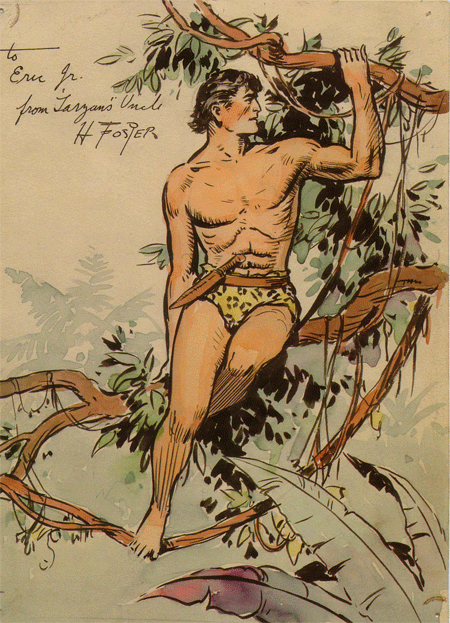
At 29, Hal Foster bicycled from Winnipeg to Chicago. He was in search of a new market, having already achieved the dubious title of most popular illustrator in Winnipeg. Seems like the stuff of a Guy Maddin film, but, nope, it was just Foster, one of our sportier cartoonists (there are apocryphal stories of the artist shooting wildlife out his studio window.) That was in 1921. Ten years later he became the regular artist on the Tarzan comic strip, and six years after that began publishing his masterpiece, Prince Valiant.

I came to Foster and Prince Valiant just recently via Wally Wood. Wood’s trees, the artist long maintained, were Foster’s trees, and Wood’s sense of composition and figures in motion was heavily influenced by Foster’s balanced and graceful panels. Sure I’d read Foster before, but I’d never found a way in. Fortunately, Fantagraphics recently released Prince Valiant Vol. 1: 1937-38, and I was able to absorb the material in a wholly new way. After doing some reading I dug up a copy of The Comics Journal 102 (1985), which features a fascinating interview by Arn Saba (also look for her Caniff and Gottfredson interviews in other issues) with a then-retired Foster. He comes across as a melancholy man but confident man, as humble about his work as he was sure of his abilities. Asked about his inspirations, Foster replies, “I would say inspired by the beauty of my own work, and the loveliness of the stories that I stole from better authors. I always worked alone.” On more cartoony strips: “I don’t know why it is that some fellows can draw a little kid like, what’s his name, Charlie Brown, with just a round head, a round nose, and no particular body, and yet give the thing a personality. I still can’t understand that, and where the little things he says, and the funny little illustrations, are more real than some of the best drawn strips, the adventure strips.” Yes, that’s the master of comic strip realism talking about the virtues of a simpler approach. Or at least the virtues of Schulz. Intangible authenticity and emotional “reality” are not the first things one thinks of when approaching Foster, but as Saba so eloquently explains in her long introduction to the interview, in many ways they are the crux of what his work. In Prince Valiant, “Foster created the quintessentially American interpretations of the King Arthur legends, complete with a nuclear family, the democratic ideal, and the man-child hero whose boyish hi-jinks often lead to high adventure.” Saba tightly defines Americana here, and to that list I might add “idealism tinged with tragedy”, as the strip begins with the boy Prince losing his mother and embarking on a solo quest to find himself. Foster imbues this and all of the other strips I’ve read with a modest humanity. Where Foster’s illustration heroes N.C. Wyeth and J.C. Leyendecker tended towards grandiosity and dynamism Foster emphasizes the human scale of these adventures and keeps things relatively quiet.

I can see where readers might cringe at Foster’s idealism and, well, cleanliness. There is nary a hair out of place, no nod to the dirt, grime, and grotesqueries of the time. Even when Val skins a goose and wears its skin as a mask — a mask later swiped by Jack Kirby for his character The Demon — it’s bloodless. But Foster’s sensibility is so wonderfully innocent and immersed in depicting virtue and honor that to let anything else in would have polluted a clear, defined well of ideas. Prince Valiant is a perfect pre-angst fantasy in which rational justice wins out.

Foster’s artwork completely reinforces the ideal order. The page above is arranged with larger set-up and concluding panels sandwiching a middle section of rapid action, expertly choreographed so that readers can follow Val in and out of a room, and then savor the ultimate conclusion in the last couple panels. A demonic but playful Val, a terrified Ogre, and finally a clearly victorious hero. The figures, while well posed, are never stiff — they have an inner life and animation. Also, Foster, while a stickler for detail, knew when to leave it out: Most of the action plays out against solid colors — yellows and blues expertly rhyming with one another to create a unified page.

This page is remarkable for its wide range of approaches, settings and emotions. In the beginning Val make an emotional proclamation (swiped from a film still, perhaps?) and then Foster races him off to the forest. Look at that bottom left panel. After a couple panels of plain backgrounds, Foster immerses us in the forest (A damn straight Wally Wood forest) with great detail and then, with some flourish, exists Val onto a plateau above the “sinister castle” a skull perched just behind him. Val is on the cusp, and the weight of his adventure is made evident by the panel size and velocity of the action. Meanwhile, the yellow of Val’s shirt picks up his cloak, while the various browns of the woods and cloth are all delicately arranged for maximum readability.

Both of these pages also reveal a key part of Foster’s appeal: He shied away from the chiaroscuro and noir angularity of the Caniff-ian school of adventure comics and instead kept his spaces fairly level, colorful and enticing. These are comics that look accessible but contain a tremendous amount of quiet sophistication. Foster’s sense of place, color, and body language is just stunning. But again, he was never showy. It’s a realism that never calls itself “realistic”.

And the story itself? I thoroughly enjoyed it. Foster himself seemingly didn’t have great ambitions besides to write something that satisfied him and entertained his readers. I found this first book completely engrossing. Prince Valiant opens up a world that I wanted to stay in — a wide-eyed early 20th century approach to fantasy with a now-vanished sincerity and wholesomeness. It’s an all too rare pleasure in comics. I now understand why so many cartoonists after him sought to regain that Foster magic, despite the futility of such an anachronistic exercise: It’s a near-perfect distillation of purity (the high moral pulp sought by mid-century guys like Gil Kane and Alex Toth), skill (inarguable drawing ability), and success. Wally Wood chased it his entire career, and was asked to try out to be Foster’s replacement on the strip, but was not given the gig. But everyone from Russ Manning (who was an heir to Foster on Tarzan) to Charles Vess to Ryan Sook (his Wednesday Comics Kamandi) have tried to claim a little bit of Foster’s legacy. And of course the comic strip itself continues under different hands. But it is not so much the characters I’m attached to, but rather Foster’s masterful spell.

I confess to not having anything terribly profound to say about Foster. I suppose I’ve been surprised by and taken with the sensitivity, grace, and fluidity of his work, as well as what a fine comic strip Valiant really was. Foster understood page design and the interplay of color and form about as well as anyone I can think of in the 1930s, but recently he tends to be relegated to illustration rather than comics history. Certainly I’ve made that mistake. The recent reprint publishing activity has had all sorts of interesting effects, particularly in the way certain artists are re-contextualized. The revival and re-packaging of Valiant is particularly significant, as it no longer seems like an oddball project in the Fantagraphics catalog, but rather a prestige item that takes it place alongside other relevant books like Love and Rockets and, dare I say, Prison Pit (in terms of cartoon clarity and craft, the two have something in common. I also loved Prison Pit). This new project gives Valiant something it was long missing: currency. And I’m looking forward to exploring more of it in the years to come.

Labels: , , , , , , , , , , , , , ,

Rerun


by

Saturday, September 5, 2009


Post Comment


I wanted to post something fun for this weekend. But honestly, I don’t have the time to write about all the awesome old comics my pal Robin McConnell just sent me in the mail. (Can you say, “Blazing Combat f**cking rulez”?) I guess I’ll have to save that for next time.

So, I thought I’d post a link to an old favorite of mine from the CC archive. It’s a post about Jack Kirby’s last issue of Mister Miracle and how Kirby uses a sort of personal symbolism. It was a fun post to write and there are a lot of great comments in the comments section by Dustin Harbin, Charles Hatfield, and Dash Shaw amongst others. So, I encourage you, True Believers, to check it out and add your voice to the exchange.

Please click here to continue reading.

Labels: ,

John Stanley and the Two Gregory Gallants


by

Friday, September 4, 2009


Post Comment

In the world of comics there are two Gregory Gallants, both of whom bear the imprint of John Stanley. The more famous Gregory Gallant is the Canadian cartoonist Seth (Gregory Gallant being Seth’s birth name).

Stanley, it’s fair to say, has many admirers but few advocates. As compared to Jack Kirby or Will Eisner, there haven’t really been many books or essays celebrating Stanley’s work (the fine blog Stanley Stories, maintained by Frank Young, is an exception). The Canadian cartoonist has long been one of the most vocal champions of Stanley’s oeuvre, recently designing the beautiful new series from Drawn and Quarterly that is reprinting such Stanley works as Nancy, Melvin Monster and Thirteen. Seth has also written the single best essay on Stanley’s work, which ran in the Comics Journal # 238, an eloquent examination of Stanley’s teen trilogy.

If we’re living through a John Stanley renaissance right now, Seth deserves much of the credit. (Along with, of course, the fine people at Dark Horse and D&Q).

Seth’s work has been strongly shaped by his love of Stanley. This can most easily be seen in Seth’s graphic novel Wimbledon Green, which can be read as an extended homage to Stanley. From the glimpses we get of it, Wimbledon Green’s favorite comic, Fine and Dandy, seems like a lost masterwork by Stanley, with the great cartoonist’s typical focus on character and recurring plots. The hobo theme in Fine and Dandy is perhaps a distant echo of the many tramps that populate Stanley’s universe (there is a memorable story where Tubby makes a stab at hobo-dom). And Wimbledon himself is a Stanley-esque creation: he’s Tubby all grown up. Like Little Lulu’s chubby pal, Green is an overgrown romantic egoist who uses his fecund imagination to bend reality to fit his flights of fancy. The way that Seth organizes his comics, with each page as a unit of attention, owes something to Stanley as well.

In the introduction to their fabulous new Toon Treasury of Classic Children’s Comics, Art Spiegelman and Francoise Mouly note that, “the melancholy in many of today’s more emotionally resonant graphic novels can be found right below the surface of John Stanley’s work.” Certainly Seth’s melancholy shares an affinity with Stanley’s similar tropism towards a spirited, lightly masked disconsolation.

There is also a parallel to be found in a recurring family dynamic. In Stanley’s work, the family is a mom-centered affair, with dad being a distant, absent or cold figure (most menacingly in the form of Baddy, the abusive patriarch in the Melvin Monster series). When in trouble, Stanley’s kids almost always cry for their mom. The same family-situation, perhaps rooted in the autobiography of both cartoonists, shows up in Seth’s work.

But nearly a decade before Seth was born, there was another Gregory Gallant. In Little Lulu #60 (June 1953), we find a story called “Rich Little Poor Boy” which features a run in by Lulu with Gregory Gallant, described as “the big movie star.” Like Seth, Gregory Gallant wears a stylish suit and has a way with the ladies. “All the girls are crazy about him!” exclaims Lulu’s boisterous little pal Annie. But in contrast to the modest and gentle Seth, the cartoon Gregory Gallant is stuck up and mean-spirited. (This story can be found in the Dark Horse book Queen Lulu, volume 14 of their Lulu reprint series).

Artists, I’ve often noticed, create their own family tree, discovering through influence their ancestors and giving birth to unexpected descendants. In the case of John Stanley, he created Gregory Gallant twice over.

Labels: , ,

Crumb and Mazzucchelli in Bookforum


by

Wednesday, September 2, 2009


Read Comments (2)

Over the last two years or so, Bookforum has emerged as one of best venues for alert comics criticism that is both informed but engages a mainstream audience. So I was pleased that Bookforum asked me to review Crumb’s new Genesis book. The review can be found here. The latest issue also has Dan’s review of Asterios Polyp, available here. Aside from taking comics seriously, Bookforum is a great review journal, wide-ranging and smart. It’s open to young writers in way that The New York Review of Books and other venerable journals just aren’t. There is much in the latest issue that merits attention, particularly Scott McLemee’s review of David Harvey’s new book.

Labels: , , , ,

Black History


by

Tuesday, September 1, 2009


Read Comments (22)

Here’s another urgent cultural-history question for you: Does anyone out there know who was the first cartoonist to depict a scene taking place in darkness via a completely black panel?

I ask because without quite outright stating it, Michael Farr, in Tintin: The Complete Companion, strongly implies that Hergé originated the technique in his first Tintin adventure, Tintin in the Land of the Soviets. (Interestingly, Farr theorizes that Hergé may have intended the panel as an homage to Malevich‘s famous Black Square, seen below.)


Does anyone know if Farr’s right? Is it possible that no one had employed the technique earlier than Hergé did in 1929/1930? The Looney Tunes film series didn’t get started until 1930, so Daffy Duck didn’t get there first…

I don’t know the answer, but whoever did it first was a genius.

Labels: , , , , ,

Ben Katchor Interview pt. 2


by

Saturday, August 29, 2009


Read Comments (3)


Part two of an interview with Ben Katchor. Please click here to read the first part. This interview originally appeared in Destroy All Comics #5 (1996).

Santoro: What about non-urban settings? Some of the strips from late ’95 that are running now in early ’96 take place outside the city.

Katchor: I’m curious about smaller towns. I’ve spent some time upstate [New York].

The city is a strange magnet for everyone outside of it and that’s what I usually talk about.

Santoro: I don’t necessarily see your work in just an urban setting.

Katchor: I’ve done strips that take place on the periphery of the city. But, I’ve always lived in a city and that’s usually what I tend to use in my strips.

Santoro: Did you grow up in New York?

Katchor: Yeah, in Brooklyn. So, it’s more or less what I know. I’ve done strips set in other locales, but they would always have something to do with what I know.

Santoro: I get that from your strip. It’s one of the only “real” depictions of New York. The New York that you depict is one, I think, that actually exists…and I think there’s a sense of modern tragedy that comes through…

Katchor:

Santoro: Silence! Ha!

Katchor: Well, yeah. Always I like to have both comedy and tragedy in my strips. And the sort of thin line dividing them should always be apparent.

Santoro: Does it bother you that some people like the humorous angle too much?

Katchor: No. They’re both there.

Santoro: I only ask this because your books are in the Humor section in bookstores.

Katchor: Well, that’s where they put the comics. But no, there’s clearly a humorous angle to it. It’s just fairly dark humor.

Santoro: I’d like to ask you a little bit about your process, if you wouldn’t mind. Sometimes I get the idea when I read a strip of yours that … it’s so effortless and so casual that it might be done “first take.”

Katchor: I write them first. Well, I guess there are early ones that were written pretty effortlessly … and I draw directly in ink so…

Santoro: I thought that.

Katchor: They shouldn’t look too labored. They should look as quickly done as possible.

Santoro: That’s what I mean… They’re so conversational.

Katchor: Well, I spend a lot of time with the writing… Since I draw directly, you’re only seeing the last layer of ink. You’re not seeing what I whited out. The final layer that you see only took a few minutes to draw. When the strip started running larger in the [Village] Voice, the strip became a little more dense. And that’s the only difference, I think. The drawing became more… I just began to put more things in, I don’t know. I don’t know where the strip is going but … it’s still going.

Santoro: I must say I’m enjoying the way the strips — the way it’s going, it’s getting … kind of growing exponentially.

Katchor: (laughs)

Santoro: Sometimes Mr. Knipl will drop out of the strip. Or he’ll be such a casual observer. One of the recent ones I remember was The Kapish Restaurant.

Katchor: Yeah, that’s also a radio show, The Double-Talk Artist.

Santoro: Do you find yourself writing for the radio show … meaning, you’re drawing a strip and thinking…

Katchor: Thinking that it’ll be used for—

Santoro: —the radio?

Katchor: No, I just try and get a decent strip out and some of them work on the radio. “Work” meaning they are possible to translate. Others are not. No … if I thought too much about it … I’d go mad.

Santoro: (laughs)

Katchor: I just think of getting the strip done.

Santoro: Right. Do you have any thoughts about doing a long story?

Katchor: Well, there’s a long story at the end of Cheap Novelties.

Santoro: Sure, I know, but a long story not necessarily of Mr. Knipl?

Katchor: Oh, other than? I don’t know if that’s best for me.

Santoro: Really? Because when I read that Picture Story

Katchor: The long story?

Santoro: Yah, it was like 23 or 25 pages and—

Katchor: I don’t know if people have the patience to read those stories. I think they can barely read eight panels…

Santoro: Oh, you’re crazy.

Katchor: I don’t want to… I mean, I’m aware of making this accessible.

Santoro: Would you consider doing it if someone approached you and said—

Katchor: I can do it anytime. I mean, I’m working on a another story, the length of the one in Cheap Novelties, for the next collection.

Santoro: Of Knipl strips?

Katchor: Yeah, the long story is a Knipl story. But… I don’t know if that is the power of the form. People sort of take them in bite-sized pieces, and when you get longer strips I think it’s overwhelming.

Santoro: No, I totally know what you’re saying—

Katchor: For readers.

Santoro: Sure, sure.

Katchor: It’s like making a five-hour movie. You can do it and it can be a successful movie but no one will want to sit through it. So, it builds in other ways. A weekly strip builds over time. It doesn’t build as a… (pauses)
Santoro: I feel like in some sense the strip is one long narrative.

Katchor: Yeah, that thing I did, The Jew of New York, is 52 pages long. But each of them could be read as a weekly story. And you could almost read them independently of each other in a strange way. So it’s definitely something to consider. What the reader can endure, and what the form is… I mean, it’s a pretty dense form. It’s not like a hundred page novel. A hundred-page novel is not like a hundred-page comic strip. There’s a certain power… You can set up a lot in a few panels. Not just the page count, but in content as well.

Santoro: So how do you feel about Cheap Novelties as—

Katchor: Well, it’s a collection. You can read it a page at a time and put it down. People who read comics, who are obsessed with the actual form, can plow through a hundred page comic novel. But I don’t know if that’s the ideal form for comics. I just know what people read, and what people can assimilate and respond to… (pause) So I’m pretty conscious of that. Whether there is a place for these to appear and how people can take them in.

Santoro: Right. I think a lot of people doing comics these days are wondering just that.

Katchor: There are other ways to lure people into your strip world. These weekly strips seem fairly painless to people. If a strip of that density went on for two pages — they’d be lost. I think that’s all part of the medium. How much your audience can take in. Most people are not obsessed with comics.

Santoro: (laughs)

Katchor: There’s a small audience of people who are. Other people want it as … it’s a very peripheral thing in their lives. If they see one that they like, that’s enough for them. I mean I tried to publish a comic magazine, and I realized that it’s probably not the way to get people to read comics. It’s better implanted in other kinds of magazines. People will read it because it’s in another context they like. Y’know, people who are interested in the World Wide Web will come across my strip in Virtual City magazine and read it, but never look at Cheap Novelties in a bookstore.

Santoro: How do you feel about strips on the Internet?

Katchor: It seems like a good idea. You don’t have to warehouse all that paper.

Santoro: (laughs) Personally, it bothers me.

Katchor: What? That it’s not on paper?

Santoro: Yeah.

Katchor: Yeah, I can’t believe that an audience would accept such an intangible medium. But then movies and TV are all just—

Santoro: Dots on a screen.

Katchor: Just pixels, dots and bits of light, so y’know, I could see … I mean, I knew alot of these weeklies who used to depend on the low price of newsprint are now in trouble because the price of newsprint has quadrupled or something. They’ve all tried to figure it out, I’m sure. How to set up some part of their paper on an online service. Y’know, these things [computers] are in everyone’s home. It’ll probably be a viable medium.Santoro: I look forward to the day you can print out a-

Katchor: A good hard copy? Yeah, the thing is… on a very good monitor, a good scan of my strip looks better than it does in any newspaper. It looks like this perfect transparency of the artwork, a perfect slide of the artwork.

Santoro: Well, that sounds good, I just—

Katchor: It’s all relative. It’s all dependent on the end user’s monitor. It’s all there.

99% of [the Internet] is like everything else in the culture … garbage. But it’s just a medium, some good things will be on it, that’s all. Spending hours looking around on this thing … you sort of hit on these little nooks and crannies of people who have things that are of interest, but that’s a tiny portion of it. But that’s how you find things in the real world. On TV or in the movies, you have to find it. Most of it is just advertising.

Santoro: I think that’s what my fear is, that like TV, it’ll just become an advertising medium.

Katchor: Well, like TV, it’ll have sponsors. But, y’know, someone sponsors these newspapers I’m in. A lot of the advertisers are indirectly paying my salary. So it’s all advertising driven anyway.

Santoro: Well, it’s part of the culture, like you said.

Katchor: On the web, at the moment, you don’t have to deal with these distributors of print. Which is not a very pleasant experience. The idea that it’s a direct conduit from one person’s scanner to another person’s monitor is not a bad idea. I mean the paper thing is gone. There could always be a paper version of it, a collection, a book you want to hold in your hand. It’s definitely a different experience. So, I mean, it works as a medium of distribution of information. It does work. The thing is, who’s gonna pay for it, who’s gonna be on it.

Santoro: Everyone’s a star.

Katchor: Yeah, that’s strange. Those personal home web pages … but we grew up with fanzines. Comic fanzines were not much different. Although there was always more to them. These web pages are pretty thin in terms of content.

Santoro: (laughs)

Katchor: I just don’t think people want to be publishers and most people don’t want to do this. People will get sick of it, and some people will go into web publishing and hopefully do something good. Y’know, these things have been around. Fanzines have been around. Hopefully it’ll all shake down to something usable.

Santoro: It would definitely help distribution.

Katchor: It’s no solution. It’s still much too slow. It’s in its technological infancy. The key to it is what we can use.

Santoro: I have one last question. For some reason, I think you might have been influenced by Steve Ditko’s work.

Katchor: Oh yeah, he was … probably as a kid, my favorite.

Santoro: It’s something I couldn’t describe—

Katchor: Well, how to build a figure. How to conceptualize figures, a great sense of place in each panel. A unique style…

Santoro: Okay, well, is there anything you’d like to add or address?

Katchor: No. It’s all in the strips.

Santoro: Well, thank you. I hope this wasn’t—

Katchor: Very painless, no…

Labels:

Not Comics: Picasso’s hidden imagery


by

Friday, August 28, 2009


Read Comments (5)

Hey everybody, Frank Santoro here with a “Friday distraction” of sorts. I taught some classes over the summer about classical painting structures and composition as they apply to comics. During the class I often referred to a book entitled Picasso’s Guernica – Images within Images by Melvin E. Becraft. It’s a fascinating read. It’s a “map” to look at Picasso’s most famous painting in a new way.

Not comics, but definitely something to chew on. Enjoy!

The pdf of Becraft’s book is here.

Also, this essay on the subject is interesting as well.

Labels: , ,